

Schmidt Hammer Test: What Is It And Why Do You Need One?

By Kerry Cooper
Founder & Lead Geotechnical Engineer
When you’re working on any existing structure, be it a building, bridge, or a slab, one of the first questions that pops up is: Is the concrete strong enough?
And this is quite tricky to answer as you can’t just look at it and tell.
Plus, drilling into the structure to take samples is often not an option either, as it’s expensive, time-consuming, and sometimes not even allowed.
Now, this is where the Schmidt hammer test comes in really handy. It is a super quick and non-destructive way to check the concrete’s strength.
The best part: It is used all over the world for field concrete testing.
In this blog, I will tell you exactly what Schmidt hammer testing is, how it works, what it tells you, and when it’s the best option.
No jargon, just simple, straightforward answers to help you understand what this test can really do for you.
So, let’s get started.
Key takeaways
- The Schmidt hammer concrete test is a fast, non-destructive way to check concrete hardness.
- It is perfect for quick assessments and spotting weak spots in older concrete.
- Results from the test are an estimate, not an exact measure of strength.
- It is low-cost, portable, and gives immediate feedback.
- Not suitable for final strength certification or testing new concrete.
- Engineers often use it alongside other tests for more accurate results.
What is the Schmidt hammer test?
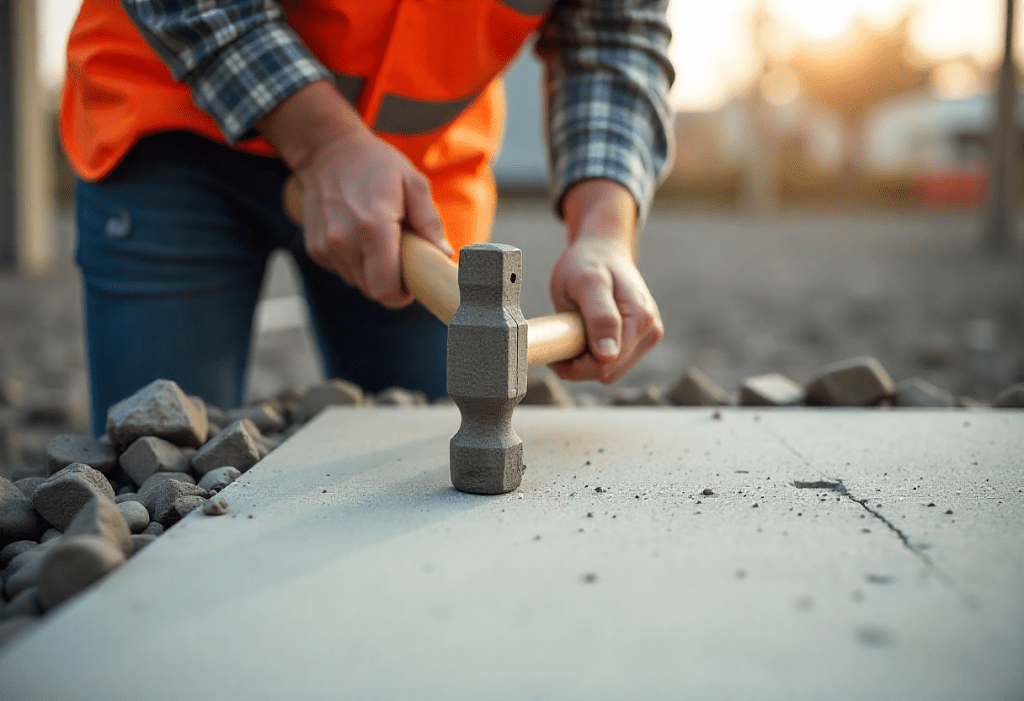
The Schmidt hammer test, also called the rebound hammer test, is a quick and non-destructive way to check how hard concrete is.
Here, instead of drilling or damaging the concrete, the test uses a spring-loaded hammer that strikes the surface.
The harder the concrete, the more the hammer bounces back, this bounce is measured as a rebound number.
Now, this number gives engineers a quick idea of the concrete’s quality and uniformity. Also, it provides a rough estimate of its strength.
However, the Schmidt hammer doesn’t give you a precise measure of the compressive strength of concrete.
But when used correctly, it does give you a general sense of how strong the concrete might be without causing any harm to the structure.
Don’t Let Site Conditions Delay Your Project
From geotechnical reports to environmental assessments, and more, our ACI-certified experts deliver the data and insights you need to stay on schedule.

How does the Schmidt hammer work?
The Schmidt hammer is actually a pretty simple tool.
Here, a spring-loaded plunger is installed inside the hammer. And it measures how hard the concrete surface is.
Here’s how it works:
- The spring releases a fixed amount of energy: When the hammer is pressed against the concrete, the spring is compressed, and it releases a set amount of energy onto the surface.
- The plunger strikes the concrete surface: The spring pushes a plunger forward, and it hits the concrete with a little force. This is where the test happens.
- The mass rebounds: After the plunger hits the surface, the energy causes it to bounce back. The harder the surface, the less it will compress, and the more it will rebound.
- The rebound distance is measured and displayed as a number: The distance the plunger rebounds is then measured, and it’s shown as a number on the hammer. This number is essential to understanding the surface’s hardness.
- The number tells us how hard the concrete surface is at that specific spot: A higher rebound number means the surface is harder, while a lower number shows it’s softer and potentially weaker. This helps engineers assess the concrete’s overall quality.
Why do engineers use the Schmidt rebound hammer test?
The Schmidt rebound hammer test is mainly popular because it’s quick, easy, and doesn’t cause any damage to the concrete.
In fact, engineers love it for its simplicity and the fact that it gives instant results. It is a go-to tool for many reasons, including:
- Assessing concrete quality without damaging the structure: You can check how strong the concrete is without having to drill into or break the structure.
- Comparing strength across different areas of the same element: It is also great for comparing the strength of concrete in different parts of a slab, wall, or beam, helping engineers spot any weaker spots.
- Identifying weak or deteriorated zones: It can help find areas that may have weakened over time or are starting to deteriorate by testing in different spots.
- Performing quick site checks during inspections: For a fast, on-the-spot check, the Schmidt hammer is perfect. It allows engineers to gather useful data quickly without delays.
- Deciding whether further testing is needed: If the Schmidt hammer test shows any concerns, engineers can decide if more detailed testing (like concrete core testing) is needed.
For older buildings, bridges, slabs, and columns, a rebound hammer test is often the first test engineers use when they need a quick understanding.
In short, here’s why Schmidt hammer concrete test is used:
| Purpose | Benefit |
| Assess concrete quality without damage | No drilling or breaking needed, and you get quick, non-destructive results. |
| Compare strength across different areas | Helps spot weaker spots in different parts of a structure. |
| Identify weak or deteriorated zones | Pinpoints areas that have weakened or started to degrade. |
| Perform quick site checks | Instant results for fast, on-the-spot condition checks. |
| Decide if further testing is needed | If needed, guides decisions on more detailed testing, like core sampling. |
What does the Schmidt hammer test tell you, and what it doesn’t?

The Schmidt hammer test is super useful, but it’s important to keep your expectations in check.
Realistically speaking, here’s what you can use it for:
- Comparing concrete quality between different areas: You can easily compare the strength of concrete in different parts of a building or structure.
- Identifying weak or deteriorated zones: It helps spot areas where the concrete may be weaker or starting to break down.
- Checking the uniformity of concrete placement: It shows the evenness of concrete that has been poured and set in different areas.
- Quick condition assessments: It is great for a fast, on-the-spot check of overall concrete health.
However, there are things the Schmidt hammer doesn’t do, including:
- Final strength certification: It doesn’t give a precise, official measure of strength.
- Acceptance testing for new concrete: It’s not the right test for new concrete being poured, and you should instead do a concrete slump test.
- Precise strength calculations: It provides an estimate, not an exact number.
Think of the Schmidt hammer as a screening tool. It gives a quick idea, but it’s not the final word on concrete strength.
What are the advantages and disadvantages of a Schmidt hammer test?
The Schmidt hammer concrete test has become a favorite among engineers for good reasons. But like any tool, it has its ups and downs.
Let’s look at both the advantages and limitations of this test so that you understand when it’s the best choice and when it’s not.
Advantages of Schmidt hammer test:
1. Completely non-destructive
One of the biggest benefits of the Schmidt hammer test is that it doesn’t damage the concrete in any way.
You can get useful data without drilling, breaking, or harming the structure. This is especially important for existing buildings or bridges where you want to avoid making any changes.
2. Fast and easy to perform
The test takes only a few minutes to carry out, making it ideal for quick assessments. There is n o need for lengthy preparation, just press the hammer to the surface and get your results almost instantly.
3. Portable and inexpensive
The Schmidt hammer is small, lightweight, and affordable. And it is easy to carry around a job site.
Plus, you won’t need to break the bank to get one. This makes it a go-to tool for engineers on a budget.
4. Immediate results on site
You get the rebound number immediately after each test, so engineers don’t have to wait for lab results.
This ensures faster decision-making, especially on large projects or during routine inspections
5. Ideal for existing structures
This test is perfect for evaluating older structures like buildings, bridges, or slabs. It is a great first step to see if there are any areas of concern that might need more thorough testing later on.
Limitations of Schmidt hammer test:
1. Measures surface hardness, not core strength
While the Schmidt hammer gives an idea of how hard the surface is, it doesn’t measure the full strength of the concrete.
So, it’s not a substitute for tests like core sampling, which give more accurate readings of overall strength.
2. Results vary with surface condition
Things like moisture, age, and how smooth the surface is can all affect the rebound number. So, two spots of concrete that are technically the same could show different results based on these factors.
3. Requires calibration and experience
For the best results, the Schmidt hammer needs to be properly calibrated, and the person using it should know how to interpret the data. Poor calibration or lack of experience can lead to misleading results.
4. Not suitable as a standalone acceptance test
If you’re testing new concrete or need to give a final strength certification, the Schmidt hammer isn’t the right tool. It can be used as an early screening tool, but you still need tests like concrete PSI testing to understand concrete quality.
In short, here are all the advantages and disadvantages of rebound hammer test for concrete:
| Advantages | Disadvantages |
| Non-destructive: No damage to the structure | Estimates only: Does not give precise strength |
| Fast and easy to perform: Results in minutes | Surface condition matters: Moisture, smoothness, and age can affect results |
| Portable and inexpensive: Easy to carry and affordable | Requires calibration: Inaccurate results if improperly calibrated |
| Immediate results: Instant feedback on-site | Not for final testing: Not suitable for new concrete or final strength certifications |
Bonus: Here are all the factors that affect Schmidt hammer readings
Rebound numbers can change due to several factors, even if the concrete strength hasn’t changed.
Factors that can affect the results include:
- Surface moisture
- Carbonation of older concrete
- Aggregate type and size
- Surface smoothness
- Concrete age
- Direction of testing (gravity effect)
How is the Schmidt hammer test different from concrete core testing?

While both the Schmidt hammer test and concrete core testing are used to assess concrete strength, they work in very different ways.
Here’s a quick comparison to help you understand when each test is the best choice:
- The Schmidt hammer is non-destructive, meaning it won’t damage the concrete. On the other hand, core testing requires drilling into the concrete, which can alter or weaken the structure.
- The Schmidt hammer provides immediate results, while core testing takes longer because the samples need to be analyzed in a lab.
- A rebound hammer is much more affordable, while core testing involves higher costs due to labor, equipment, and lab analysis.
- The Schmidt hammer gives an estimate of concrete strength based on surface hardness. Core testing, on the other hand, provides a more precise measure of actual compressive strength by testing samples.
Schmidt hammer vs core testing: Here are all the differences in short
| Feature | Schmidt Hammer Test | Core Test |
| Destructive | Non-destructive | Destructive (requires drilling) |
| Speed | Fast results | Slower (requires lab analysis) |
| Cost | Low cost | Higher cost |
| Strength Measure | Estimates surface strength | Measures actual compressive strength |
| Use | Screening tool, quick checks | Definitive test, precise results |
Don’t Let Site Conditions Delay Your Project
From geotechnical reports to environmental assessments, and more, our ACI-certified experts deliver the data and insights you need to stay on schedule.
Conclusion
The Schmidt hammer test is one of the most practical tools in concrete evaluation. It is fast, non-destructive, and incredibly helpful when used the right way.
And although it doesn’t replace laboratory strength tests, it plays a crucial role in early assessments, safety checks, and decision-making.
Nevertheless, improper technique, poor calibration, or incorrect assumptions can lead to very misleading conclusions.
This is why Schmidt hammer testing should always be performed and reviewed by experienced engineers.
Got more questions or looking to hire field testing professionals?
You can get in touch with us!
At NewTech Engineering, we combine decades of field experience, engineering skills, and trusted testing methods to give you precise results.
FAQs about Schmidt hammer test
What is Schmidt hammer testing used for?
The Schmidt hammer test is primarily used to check the hardness and strength of concrete surfaces without causing any damage.
It is quick and helpful for assessing the quality of concrete in existing structures, like buildings or bridges.
This test can help engineers identify weak or deteriorating areas and decide if further testing is needed.
Is the Schmidt hammer test accurate?
While the Schmidt hammer provides useful estimates, it’s not 100% accurate for measuring concrete strength.
The test is based on surface hardness, which can be affected by factors like moisture, surface smoothness, or age of the concrete.
For precise strength measurements, core testing or other methods are often needed alongside the Schmidt hammer.
How do you interpret Schmidt hammer test results?
When it comes to reading Schmidt hammer test results, you need to interpret the rebound number which tells you how hard the concrete surface is.
Higher rebound numbers suggest a harder surface, while lower numbers indicate a weaker or softer area.
However, these results are an estimate, so the interpretation should consider factors like surface condition and concrete age.
Can the Schmidt hammer test replace core testing?
No, the Schmidt hammer test cannot fully replace core testing.
While it provides a fast and non-destructive estimate of concrete strength, core tests are necessary for precise measurements.
Core testing involves taking samples from the concrete to test its compressive strength, providing more reliable and definitive results.
What are the benefits of using the Schmidt hammer test?
The biggest benefits of using the Schmidt hammer are its speed, simplicity, and non-destructive nature.
It is portable, affordable, and provides immediate results, making it an excellent tool for quick assessments, especially on older buildings and structures.
Also, it helps engineers compare strength across different parts of a structure without causing any damage.
How accurate is the number in the concrete rebound hammer test?
The rebound number gives a good estimate of the concrete’s surface hardness and an indirect indication of its strength.
However, it is not an exact measure, and factors like surface smoothness, moisture, and aggregate type can affect the results.
It is important to use the Schmidt hammer as part of a broader assessment strategy, combining it with other tests when necessary.
Kerry Cooper is the founder of New Tech Engineering, He brings over 20 years of hands-on experience in geotechnical investigation, soil analysis, and foundation design across residential, commercial, and infrastructure projects. Kerry leads a team focused on delivering data-driven insights that help builders and developers make smarter, safer decisions from the ground up.