

Everything You Need To Know About Standard Penetration Test Of Soil

By Kerry Cooper
Founder & Lead Geotechnical Engineer

One of the most common methods engineers use to test the soil before construction is the Standard Penetration Test or SPT.
You see, the soil under a construction site isn’t always the same. Some soils are dense and strong enough to support heavy structures, while others may be loose, soft, or prone to settlement. This is why engineers perform soil testing before designing a foundation.
Now, among all soil testing methods, a SPT penetration test is considered highly reliable, especially for the different soil types in North and South Carolina.
As a geotechnical consultant, I’ve seen firsthand how a proper SPT testing has helped property owners avoid costly foundation issues later on. And if you’re planning construction work anywhere in the Carolinas, it can help you too.
In this blog, I’ve explained it all, including:
- What is a Standard Penetration Test
- Why it’s important in construction
- How the test is performed
- What the SPT N-value (or blow count) means
- When an SPT is required
And much more.
So, let’s get into it.
Key takeaways
- Standard Penetration Test is one of the most widely used soil penetration tests in geotechnical engineering.
- It helps engineers evaluate the strength and consistency of soil beneath a construction site.
- The test is performed as part of a subsurface or geotechnical investigation before foundation design.
- The SPT N-value, also called the blow count, indicates how resistant the soil is to penetration.
- The test is performed according to ASTM D1586 standards across the country.
- SPT results help engineers design safe and cost-effective foundations.
What is a Standard Penetration Test (SPT)?

To put it simply, a Standard Penetration Test, or SPT, is a field test that helps engineers determine the strength and condition of the soil at a construction site.
The test is carried out during a geotechnical investigation or subsurface investigation to calculate the bearing capacity of soil.
Here, engineers drill a borehole and lower a sampling tool into the ground. They then drive the sampler into the soil using a standardized hammer and record how many hammer blows are needed for it to penetrate the ground.
The test also provides a soil sample that engineers use to identify the different soil layers at the site.
Together, the sample and the penetration resistance give valuable information about how the ground is likely to behave under a building or other structure.
Don’t Let Site Conditions Delay Your Project
From geotechnical reports to environmental assessments, and more, our ACI-certified experts deliver the data and insights you need to stay on schedule.

Why is Standard Penetration Test important in construction?
Before you build anything, engineers need to know whether the soil can safely support the proposed structure.
That’s because the foundation transfers the weight of the building into the ground below. And if the soil isn’t strong enough, you can run into the following problems:
- Uneven foundation settlement
- Cracked walls and floors
- Foundation movement
- Structural instability
- Expensive repairs
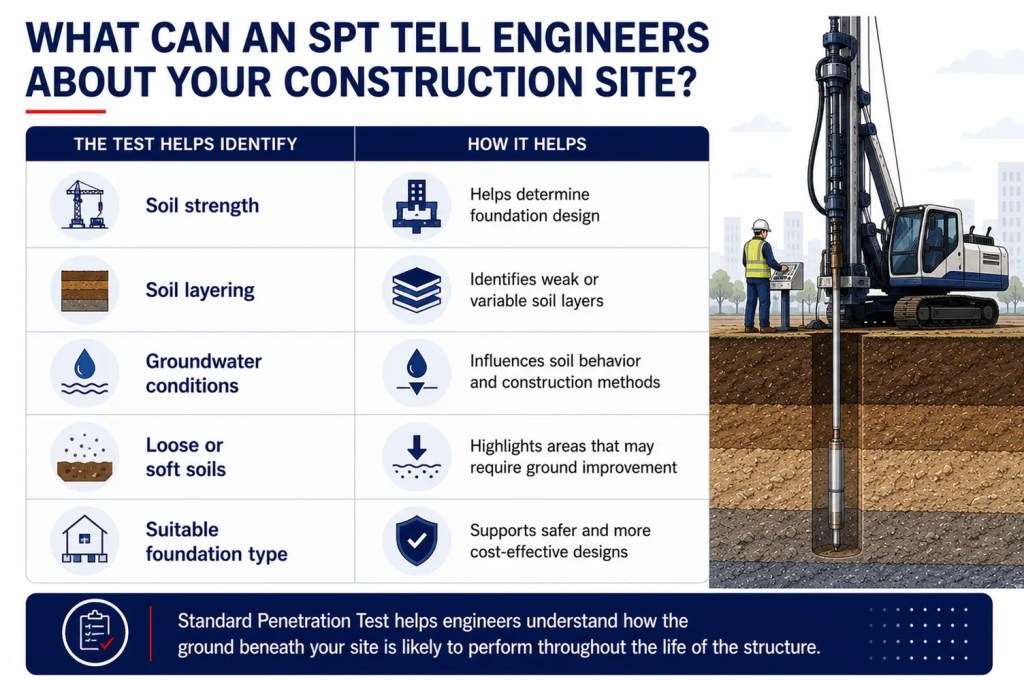
Now, engineers perform an SPT before construction to get an in-depth understanding of the soil condition. The results help them estimate important soil properties, identify weak soil layers, and design foundations that are appropriate for the conditions under the site.
The information collected during the test also helps determine whether ground improvement or a different foundation system is needed before construction moves ahead.
Simply put, soil penetration test helps reduce uncertainty. It gives engineers a clearer picture of what’s happening below the surface so they can make better design decisions that improve both safety and long-term performance.
How is a Standard Penetration Test performed?

SPT testing performed according to ASTM D1586 standards in North and South Carolina and everywhere else in the country. The standard establishes the equipment to be used, testing procedure, and reporting requirements to ensure the results are consistent and reliable.
Here’s how an SPT penetration test is done:
1. A borehole is drilled
First, engineers drill a borehole to the required depth using a drilling rig.
Depending on the project, the test might be performed at regular depth intervals or whenever there’s a noticeable change in the soil layer.
2. The split-spoon sampler is lowered into the borehole
Next, a standard split-spoon sampler is lowered to the bottom of the borehole. This sampler is designed to both penetrate the soil and collect a soil sample for testing.
3. A standard hammer drives the sampler into the soil
A 140-pound hammer is then repeatedly dropped from a height of 30 inches to drive the sampler into the soil.
Here, the hammer weight and drop height are standardized for engineers to compare results from different sites.
4. Engineers record the blow count
As the sampler penetrates the ground, engineers count the number of hammer blows required to drive it through specific intervals.
This recorded blow count is one of the most important results of the test because it helps indicate how resistant the soil is to penetration.
In short, here’s how the Standard Penetration Test works:
| Step | What Happens |
| Drill a borehole | Access the soil below the surface |
| Lower the sampler | Position the split-spoon sampler in the borehole |
| Drive the sampler | Use a standard hammer to penetrate the soil |
| Record the blow count | Measure the soil’s resistance to penetration |
What is the SPT N-value (blow count)?
Earlier, I mentioned that one of the most important results of the Standard Penetration Test is the blow count.
This blow count is what is called the SPT N-value. And it is the number of hammer blows required to drive the sampler through the last 12 inches of the test.
Here’s how it works:
During the test, the sampler is driven 18 inches into the soil. However, the first 6 inches are considered a ‘seating drive.’ This initial penetration helps the sampler move past any loose or disturbed soil at the bottom of the borehole.
Engineers then record the number of hammer blows needed for the second and third 6-inch increments. These two values are added together to calculate the SPT N-value (also called the SPT blow count).
The detailed procedure is specified in ASTM D1586.
Now, the higher the N-value, the more resistant the soil is to penetration. In general, this means the soil is denser or stronger.
On the other hand, a lower N-value usually indicates softer or looser soil that may require additional consideration during foundation design.
In short, here’s what the SPT N-value tells engineers:
| SPT N-value | What It Generally Indicates |
| Very low | Very soft or loose soil |
| Low to moderate | Medium-density or medium-stiff soil |
| High | Dense sand or stiff clay |
| Very high | Very dense or very hard soil |
Pro tip: While these ranges provide a general idea of soil strength, the N-value should always be interpreted by a qualified geotechnical engineer alongside the site’s overall soil conditions.

You might also want to read: How Much Does a Geotechnical Engineer Report Cost?
When is a Standard Penetration Test required?
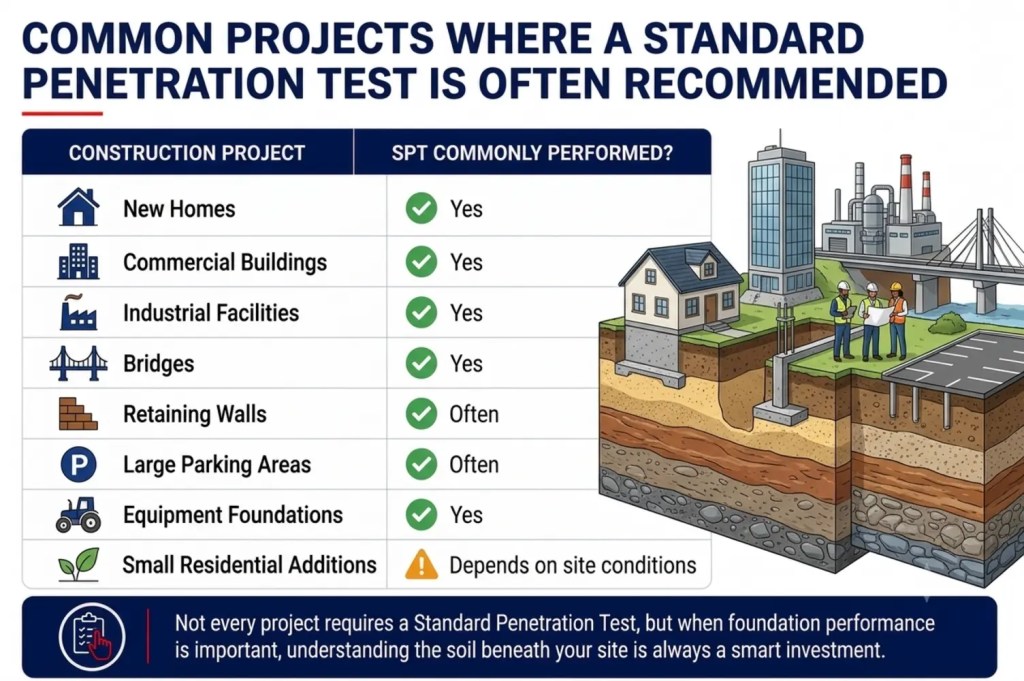
A Standard Penetration Test isn’t required for every construction project. However, it is common when engineers need to understand the soil conditions before designing a foundation.
Mostly, this type of geotechnical soil testing is carried out before construction. For instance, an SPT might be performed when:
- Constructing a new home or commercial building
- Designing shallow or deep foundations
- Planning retaining walls
- Building bridges or other infrastructure
- Investigating sites with questionable soil conditions
- Assessing land for future development
- Evaluating foundation issues on existing structures
The results of SPT help engineers determine whether the existing soil can safely support the proposed structure or whether ground improvement or a different foundation system is needed.
Bonus: Here are the advantages and limitations of Standard Penetration Test
| Advantages | Limitations |
| Simple and economical | Less reliable in gravelly or bouldery soils |
| Widely accepted worldwide | Results can be influenced by testing conditions |
| Provides a soil sample | Sample is disturbed, not undisturbed |
| Useful for foundation design | Often used together with other soil tests |
How is a Standard Penetration Test different from a Cone Penetration Test?
At first, both Standard Penetration Test and Cone Penetration Test look similar because they both assess subsurface soil conditions.
But they work quite differently.
A Standard Penetration Test measures the soil’s resistance by driving a sampler into the ground using repeated hammer blows. It also collects a soil sample for visual classification.
The Cone Penetration Test, on the other hand, pushes an instrumented cone into the ground at a constant rate while continuously measuring soil resistance. Unlike the SPT, it doesn’t collect a soil sample but provides highly detailed, continuous data about the soil profile.
Here’s a simple comparison:
| Standard Penetration Test (SPT) | Cone Penetration Test (CPT) |
| Uses a hammer to drive a sampler | Pushes a cone into the ground |
| Provides a disturbed soil sample | Does not collect a soil sample |
| Reports an SPT N-value (blow count) | Measures continuous penetration resistance |
| Common on a wide range of construction projects | Often used on larger or more complex investigations |
Don’t Let Site Conditions Delay Your Project
From geotechnical reports to environmental assessments, and more, our ACI-certified experts deliver the data and insights you need to stay on schedule.
To sum up
As you can see, Standard Penetration Test is one of the most critical tools in geotechnical engineering. It gives engineers valuable information about what’s happening below the ground before construction begins.
The test measures how resistant the soil is to penetration and collects soil samples. This helps engineers evaluate site conditions, estimate soil strength, and design foundations that perform safely over the long term.
Although SPT is a part of the larger geotechnical investigation process, it plays an important role in reducing uncertainty and helping property owners, developers, and contractors make informed construction decisions.
Got more questions or need professional geotechnical investigation services?
You can get in touch with us!
At NewTech Engineering, we provide comprehensive geotechnical investigations, Standard Penetration Testing, and soil testing services throughout the Carolinas.
Our seasoned engineers help property owners, developers, and contractors understand site conditions before construction begins, helping them design safer foundations and avoid costly problems down the road.
FAQs about the Standard Penetration Test
What does SPT stand for?
SPT stands for Standard Penetration Test. It is a commonly used field test that helps geotechnical engineers evaluate soil strength and subsurface conditions before construction begins.
What is the purpose of a Standard Penetration Test?
The purpose of the Standard Penetration Test is to determine how resistant the soil is to penetration and to collect a representative soil sample. The results help engineers design foundations that are appropriate for the site’s soil conditions.
What is the SPT N-value?
The SPT N-value is the total number of hammer blows required to drive the sampler through the last 12 inches of the test. It provides an indication of the soil’s strength or density and is one of the key results obtained during the Standard Penetration Test.
Is the Standard Penetration Test accurate?
Yes, when performed according to ASTM D1586 and interpreted by qualified geotechnical engineers, the Standard Penetration Test provides reliable information for many types of construction projects. However, it’s often used alongside other field and laboratory tests to obtain a more complete understanding of site conditions.
When is a Standard Penetration Test required?
A Standard Penetration Test is commonly performed before designing foundations for homes, commercial buildings, bridges, retaining walls, and other structures where understanding subsurface soil conditions is important.
How much does a Standard Penetration Test cost?
A Standard Penetration Test of soil can cost between $750 and $1,500 per borehole. This means the overall soil test cost can be between $3,000 and $8,000, depending on total number of boreholes.
Can the Standard Penetration Test be performed in all soil types?
The SPT works well in many types of soils, but it has limitations in very gravelly soils, soils containing large cobbles or boulders, and some very soft soils. Geotechnical engineers will determine whether the SPT, another test, or a combination of tests is most suitable for the site.
Kerry Cooper is the founder of New Tech Engineering, He brings over 20 years of hands-on experience in geotechnical investigation, soil analysis, and foundation design across residential, commercial, and infrastructure projects. Kerry leads a team focused on delivering data-driven insights that help builders and developers make smarter, safer decisions from the ground up.