
A Complete Guide To Steel Construction Foundation Systems

By Kerry Cooper
Founder & Lead Geotechnical Engineer

When it comes to building a steel structure, there’s one thing that’s most important, the foundation.
This is the first thing you need to get right because it keeps your building safe, stable, and standing strong for years.
Think of it this way: A steel building is only as strong as the foundation it’s built on.
That’s because even though steel buildings are tough and durable, they need a solid foundation to handle all the weight and pressure they carry.
You see, unlike brick structures, steel structures concentrate the load on smaller points (like columns). This means the foundation has to be engineered very carefully since even one wrong move can endanger the entire structure.
In this blog, I will walk you through all things steel construction foundation. You’ll know:
- How steel building foundations are different from other foundations
- What are the different types of foundations used in steel structures
- What factors determine the foundation used in your building
And a lot more.
So, let’s get started.
Key takeaways
- Steel buildings need strong foundations to last long and stay safe.
- The foundation type depends on soil, climate, and building weight.
- Soil testing is critical to ensure the ground can support the building.
- Slab-on-grade foundation is common for smaller steel buildings, but other foundations might be needed for larger ones.
- Foundations should be able to handle wind, uplift, and heavy loads for stability.
- Your budget and building needs primarily determine which foundation type you choose.
First of all, what makes a steel construction foundation different from others?
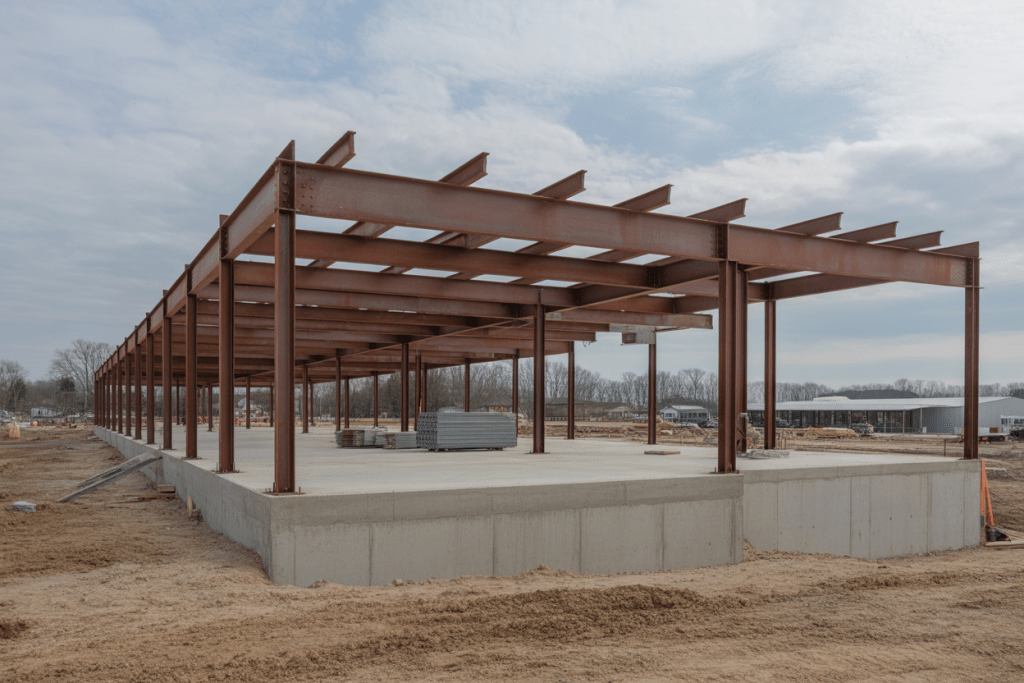
For starters, a steel building foundation is designed to be super strong compared to regular foundations. And this is mainly because of how steel structures work.
You see, unlike regular wood-framed homes or even brick and mortar buildings, steel buildings put more pressure on specific spots, especially around the columns. This makes all the difference in how the foundation is designed.
Overall, here’s how steel building foundations are different:
- Steel buildings transfer heavy loads through the columns, so those points have a much stronger base underneath them.
- The bolts that connect the steel frame to the foundation are placed with precision by seasoned engineers as even a slight mistake can delay the whole project.
- Steel buildings are more affected by wind and forces that push upward (called uplift). So, the foundation is built to handle that.
- Before anything happens, a geotechnical site investigation tests the soil to make sure it can support the building. The foundation is designed based on this test.
- The concrete used in steel building foundations has to reach a specific strength (usually 3,000-4,000 PSI) before you can start building. This ensures it can support all that steel weight.
Don’t Let Site Conditions Delay Your Project
From geotechnical reports to environmental assessments, and more, our ACI-certified experts deliver the data and insights you need to stay on schedule.

What are the different steel construction foundation types?

Just like there are different types of foundations for homes, steel buildings also use different foundations.
Each foundation is unique and serves different needs, depending on the soil, climate, and the size of your building.
I have broken down each one so you know exactly what is what.
Let’s have a look.
1. Slab-on-grade foundation (the most popular by far)
A slab-on-grade foundation is basically a thick solid concrete slab poured directly onto the ground.
And it is the most common foundation type used for a lot of smaller steel buildings, like garages or workshops.
Where is this foundation used?
It is used mainly for buildings like garages, small warehouses, workshops, or residential barndominiums.
How is the foundation designed?
A slab-on-grade foundation is designed to support both the weight of the building and provide the floor surface.
Here, the edges of the slab are thickened to make sure the walls are supported and can handle wind or uplift forces.
What are the pros and cons of slab-on-grade foundation?
Pros:
- This is one of the most affordable foundation options.
- It is quick to build as it involves a faster process compared to some other types.
- If you’ve got a well-compacted soil, it gives you a solid, long-lasting base.
Cons:
- This is not for weak soil. If the ground isn’t stable, the slab could crack over time.
- The foundation is hard to adjust. So, plumbing changes or updates are tricky once it’s set.
- It calls for precision and the anchor bolts that hold the steel frame to the slab must be exactly where they need to be. Even small mistakes can cause problems.
2. Monolithic slab foundation
A monolithic slab foundation is like a slab-on-grade but with a twist.
Here, both the slab and the footings (the part that goes into the ground) are poured at the same time. This gives the foundation extra strength and stability.
Where is this foundation used?
Monolithic slab foundations are used in smaller garages, homes, barndominiums, and storage buildings.
How is the foundation designed?
The concrete slab is poured in one go with footings underneath to give it extra support. This is a good option if you don’t need deep footings or complicated designs.
What are the pros and cons of monolithic slab foundation?
Pros:
- Since the slab and footings are poured together, it’s cheaper and faster to build.
- Works well in warm climates.
Cons:
- If you live somewhere with freezing temperatures and deep frost, this might not be the best option.
- If the columns or the building are particularly heavy, this foundation might not have the strength needed.
3. Floating slab foundation
As the name suggests, a floating slab foundation is poured on top of well-compacted gravel, and the whole thing floats on the soil. This type of foundation is pretty simple and works best for light steel buildings.
Where is this foundation used?
This foundation is mainly used for small sheds, carports, or light steel structures.
How is the foundation designed?
The foundation sits on gravel, which helps with drainage and stability. And since it doesn’t dig into the ground as deep as other foundations, it’s easier to build and uses less concrete.
What are the pros and cons of floating slab foundation?
Pros:
- You’ll save on construction materials since less concrete is used.
- This foundation is one of the simplest and quickest to construct, especially in areas where deep footings aren’t needed.
Cons:
- This foundation won’t work for larger steel structures with heavy loads.
- In places where the ground freezes and thaws, this foundation can be problematic unless it’s insulated.
4. T-shaped or frost-protected foundation
A T-shaped foundation is designed specifically for areas with cold winters.
It prevents frost heave (that is when the ground freezes and pushes up) by keeping the foundation deep below the frost line. This makes it perfect for places like Colorado or other northern states.
Where is this foundation used?
T-shaped foundations are mostly used in cold climates with deep frost lines, and in large steel buildings.
How is the foundation designed?
The foundation has a deep footing that goes below the frost line, and a vertical wall supports the structure. The slab is poured inside the walls, creating a strong, frost-resistant base.
What are the pros and cons of a T-shaped foundation?
Pros:
- The deep footing prevents shifting from frost, which is super important in freezing temperatures.
- This foundation works well for heavy steel structures that need extra support.
Cons:
- It requires more concrete and labor compared to simpler foundations.
- Since the footings and walls are deep, it takes more time to pour and set everything.
5. Pier foundation
A pier foundation uses reinforced concrete piers that are drilled deep into the ground. These piers hold the steel building columns in place, and the steel frame is anchored to them with bolts.
Where is this foundation used?
This foundation is used for buildings on uneven or poor soil, or if the building needs to be elevated.
How is the foundation designed?
Here, concrete piers are drilled into the ground to provide solid support for the building. Each column sits directly on these piers, which are spaced out around the building.
What are the pros and cons of pier foundation?
Pros:
- Pier foundations use less concrete than a full slab, making them cheaper in some cases.
- If the ground is unstable or doesn’t have good bearing capacity, piers are a great option because they reach deeper into solid ground.
Cons:
- Not ideal for heavy buildings. A slab foundation would be more suitable than a pier foundation if the building requires the foundation to carry a lot of weight
- You’ll need an engineer to first evaluate how deep the piers should be, depending on the soil conditions.
6. Perimeter wall or stem wall foundation
A stem wall foundation features a continuous concrete wall that supports the edges of the steel building, with a slab poured inside the perimeter.
This type of foundation is often used when the building needs to have tall foundation walls.
Where is this foundation used?
This foundation is used in sloped sites, high-wind areas, or buildings that need taller walls for things like crawl spaces.
How is the foundation designed?
A tall concrete wall is poured around the perimeter of the building, providing strength and stability. Inside the perimeter, a concrete slab is poured to form the floor.
What are the pros and cons of stem wall foundation?
Pros:
- The walls help resist side-to-side forces, like high winds.
- The stem wall also helps keep moisture out, which is important in damp areas.
Cons:
- It costs more than simpler foundation types because of the extra concrete and labor involved.
- Since this foundation involves a stem wall, it needs more planning and design work.
7. Trench foundation
A trench foundation is a continuous trench dug around the perimeter of the building. Here, concrete is poured into the trench to form a strip footing that supports the walls of the building.
Where is this foundation used?
It is used by medium-sized buildings like workshops, agricultural structures, or small steel buildings.
How is the foundation designed?
A trench is dug around the building’s perimeter, and concrete is poured into the trench to form a continuous footing that supports the walls.
What are the pros and cons of trench foundation?
Pros:
- This is one of the easiest and most cost-effective foundations to build.
- Whether you’re using steel or block walls, this foundation can handle both types.
Cons:
- This foundation is only for buildings with lighter loads. Steel columns with heavy loads might need something stronger.
- If the soil quality isn’t great, this type of foundation can have stability issues.
8. Anchor-bolt-and-pad foundation
This foundation consists of concrete pads that sit under each steel column. Here, a slab is added to create the floor of the building after the pads are poured.
Where is this foundation used?
The foundation is used in pre-engineered metal buildings like warehouses and workshops.
How is the foundation designed?
In an anchor-bolt-and-pad foundation, each steel column has its own dedicated concrete pad, which anchors the column securely to the ground. Afterward, the slab is poured.
What are the pros and cons of anchor-bolt-and-pad foundation foundation?
Pros:
- This foundation provides excellent support where the columns meet the ground, which is important for heavy-duty buildings.
- If your building has heavy columns or needs a lot of support, this is a solid option
Cons:
- The pads need to be placed exactly where they should go, or the building could misalign.
- Since each pad has to be placed individually, this foundation takes a lot more time to build.
Note: Sometimes, engineers use a hybrid foundation or a mix of foundation types to fit the needs of a custom steel building. This might mean combining slabs, piers, stem walls, or grade beams to create the best foundation for the project.
In short, here are all the different steel construction foundation types:
| Foundation Type | Best For | Pros | Cons |
| Slab-on-Grade | Small–Medium Steel Buildings | Affordable, quick to build, stable on compact soil | Not for weak soil, hard to adjust plumbing |
| Monolithic Slab | Smaller Garages, Homes, Barndominiums | Quick and cheap, good in warm climates | Not ideal for cold areas, not for heavy loads |
| Floating Slab | Small Structures, Carports | Simple to build, less concrete | Not for larger buildings or freeze-thaw areas |
| T-Shaped / Frost-Protected | Cold climates, large buildings | Stable in freezing conditions, strong for large structures | Expensive, longer build time |
| Pier Foundation | Poor soil, uneven ground | Uses less concrete, excellent support | Not for heavy slabs, needs soil evaluation |
| Perimeter Wall (Stem Wall) | Sloped sites, high-wind areas | Strong lateral resistance, good moisture control | Expensive, needs more engineering |
| Trench Foundation | Medium-sized buildings | Simple, affordable, works for steel and block walls | Not for heavy loads or poor soils |
| Anchor-Bolt-and-Pad | Pre-engineered metal buildings | Strong at column points, good for heavy-duty buildings | Precise layout needed, takes longer to build |
| Hybrid Foundations | Custom steel buildings | Tailored for complex sites and heavy loads | More expensive, complex to design |
What factors determine steel construction foundation type used in your building?
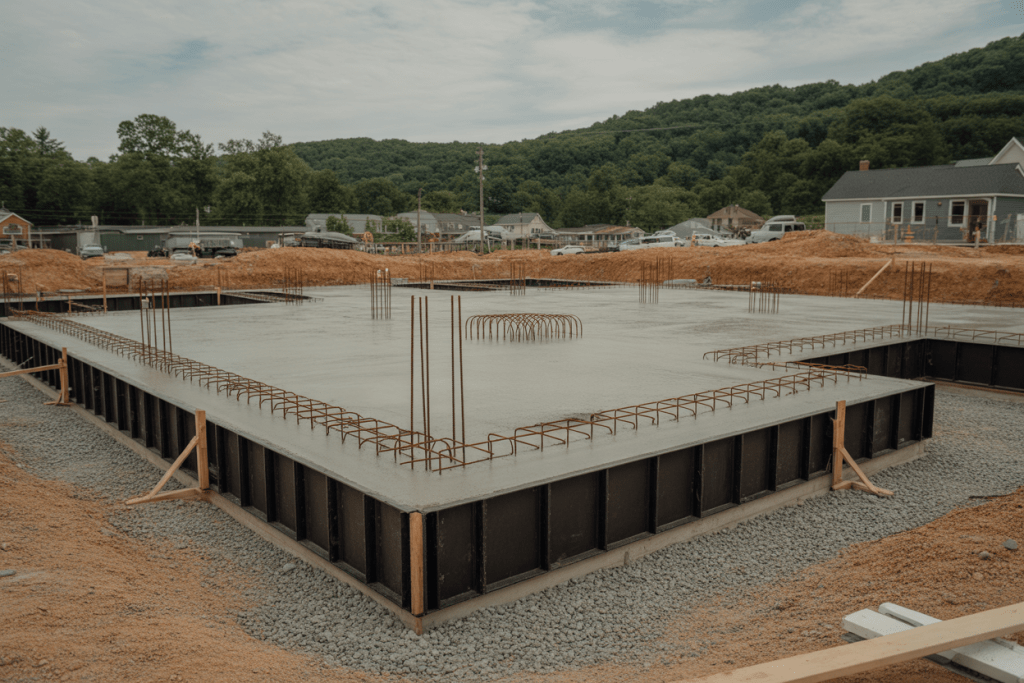
Choosing the right foundation for your steel building isn’t just about picking any type and going with it.
In fact, engineers look at several factors to make sure your foundation will be strong, stable, and fit for the job.
Here are the main factors that they consider:
1. Soil bearing capacity
Before deciding the foundation type, geotechnical engineers test the soil and prepare a geotechnical report to see how strong it is.
If the soil is weak or soft, it won’t be able to support a heavy building. And in that case, they might have to place the footings or piers much deeper to make sure everything stays in place.
2. Frost depth
If you’re building in a cold climate, the ground can freeze in winter. And to prevent your foundation from shifting, engineers choose a foundation type that’s deep enough to stay below the frost line.
3. Building size and weight
The bigger and heavier the building, the stronger the foundation needs to be.
It’s simple: Larger buildings with heavy steel frames will need bigger footings to support all that weight. Smaller buildings, on the other hand, might be okay with a simpler foundation.
4. Uplift and wind forces
Steel buildings often face strong winds that can push upwards (this is what is called an uplift).
So, the anchor bolts and the foundation itself need to be such that it can handle the extra force.
5. Building use
The type of activities in the building affects the foundation choice.
For instance, if you’re storing heavy equipment in a warehouse, you’ll need a stronger slab than if it’s just for light storage.
The foundation needs to handle the specific use and load requirements of the building.
6. Your budget and construction timeline
Sometimes, a stronger foundation may cost more upfront but can save you money in the long run by preventing future repairs. On the other hand, some foundations are cheaper but might take longer to build.
When deciding the foundation type engineers balance cost with the time it takes to construct the building.
In short, here are the factors that decide your steel construction foundation type:
| Factor | Explanation |
| Soil Bearing Capacity | Engineers test the soil to ensure it can hold the building’s weight. |
| Frost Depth | In cold areas, the foundation must be below the frost line to avoid shifting. |
| Building Size & Weight | Bigger buildings need stronger foundations to support more weight. |
| Uplift & Wind Forces | Steel buildings need foundations that can handle wind and upward forces. |
| Use of the Building | The type of activities in the building impacts the strength of the foundation. |
| Budget & Timeline | Some foundations are cheaper but take longer to build, while others are faster but cost more. |
Don’t Let Site Conditions Delay Your Project
From geotechnical reports to environmental assessments, and more, our ACI-certified experts deliver the data and insights you need to stay on schedule.
Conclusion
By now, I am sure you know everything about steel construction foundation types and how they’re different from regular foundations.
Also, you’ve got a basic idea about the factors that decide what foundation type you’ll use for your building.
Steel buildings are amazing, but they need the right foundation to last.
At NewTech Engineering, our seasoned engineers help you make sure your foundation:
- Matches your building’s needs
- Meets all local building codes
- Can handle things like wind, snow, and uplift forces
- Stops problems like settling or cracking
You can get in touch with us for geotechnical investigation services, construction material tests, soil tests, special inspections, and more.
We’re here to make sure your project starts off on the right foot, from the ground up.
FAQs about steel building foundation
What’s the best foundation for a steel building?
There’s no one best option.
The right foundation depends on your soil strength, climate, building weight, and how the structure will be used.
Most people choose slab-on-grade, but piers or stem walls are also good for weak soils or larger buildings.
Do I need a soil test before building a steel structure?
Absolutely. Steel buildings put heavy loads on small points (the columns).
A soil compaction test tells you how deep your footings need to go and what type of foundation is safe.
How long does a steel building foundation take to finish?
Most foundations take 3-10 days, depending on size. Concrete typically needs 7-28 days to reach full strength before steel erection begins.
Why are anchor bolts so important?
Anchor bolts connect your steel framing to the foundation. If they’re even slightly misaligned, the entire steel structure won’t fit. Rework can cost thousands.
This is why engineers prepare a precise bolt layout.
Can I pour the slab and set anchor bolts later?
For most steel buildings, anchor bolts are set before pouring the concrete, using a template provided by the manufacturer. Getting this wrong can delay the project significantly.
What concrete strength (PSI) do steel foundations need?
Most steel building foundations use 3,000-4,000 PSI concrete, but heavy industrial buildings may require more.
Can I use my home’s normal foundation for a steel building?
Usually no.
Steel buildings apply loads very differently from wood-frame homes. So, using a residential-style foundation can lead to cracking or failure.
Do steel buildings need rebar in the foundation?
Yes, they do. Rebar prevents cracking, increases strength, and supports heavy loads. The layout depends on building size, slab thickness, and soil conditions.
How much does a metal building foundation cost?
Costs vary widely, but most foundations range from $6-$14 per sq ft depending on the type, soil, and thickness.
Kerry Cooper is the founder of New Tech Engineering, He brings over 20 years of hands-on experience in geotechnical investigation, soil analysis, and foundation design across residential, commercial, and infrastructure projects. Kerry leads a team focused on delivering data-driven insights that help builders and developers make smarter, safer decisions from the ground up.