


What Causes Crack In Concrete Foundation And When Is It A Worry?

By Kerry Cooper

Have you ever walked around your house, looked at the foundation, and suddenly noticed a crack you swear wasn’t there before?
You might have paused for a moment and thought if that’s bad.
And this is just you.
As a concrete and soil testing expert in the Carolinas, I have noticed countless homeowners experience this at some point.
But here’s the truth: A crack in concrete foundation is very common, and it happens due to soil movement and weather changes. And it doesn’t always mean your home is in danger.
However, some cracks are also early warning signs that something underneath your home is shifting.
In this blog, I will explain what causes concrete foundation cracks, which cracks are usually nothing to worry about, and which ones deserve your attention.
So, let’s get into it.
Key takeaways
- A crack in concrete foundation is usually normal.
- Small hairline cracks are usually harmless.
- Horizontal cracks deserve serious attention.
- If a crack keeps getting wider, something is still moving.
- Displacement (uneven sides) is a warning sign.
- Cracks plus sticking doors or sloping floors need detailed inspection.
- Early evaluation saves money in the long run.
First off, a cracked foundation doesn’t always mean your home is in danger
Seeing a crack in your foundation can feel scary as your mind immediately jumps to worst-case scenarios like expensive repairs, structural damage, major problems.
But here’s something you don’t realize: Concrete cracks. It’s what it does.
In fact, even brand-new homes can develop small foundation cracks within the first year or two.
This happens mainly because, as concrete dries, settles, and adjusts to temperature changes, it causes cracks. In most cases, it’s just part of the natural aging process of your home.
What’s really important about the crack is:
- Why it formed
- What it looks like
- And whether it’s still changing
A thin crack that stays the same for years is very different from one that keeps widening or shifting, and it shouldn’t be as big of a worry.
Don’t Let Site Conditions Delay Your Project
From geotechnical reports to environmental assessments, and more, our ACI-certified experts deliver the data and insights you need to stay on schedule.

Why do you see a crack in concrete foundation in the first place?
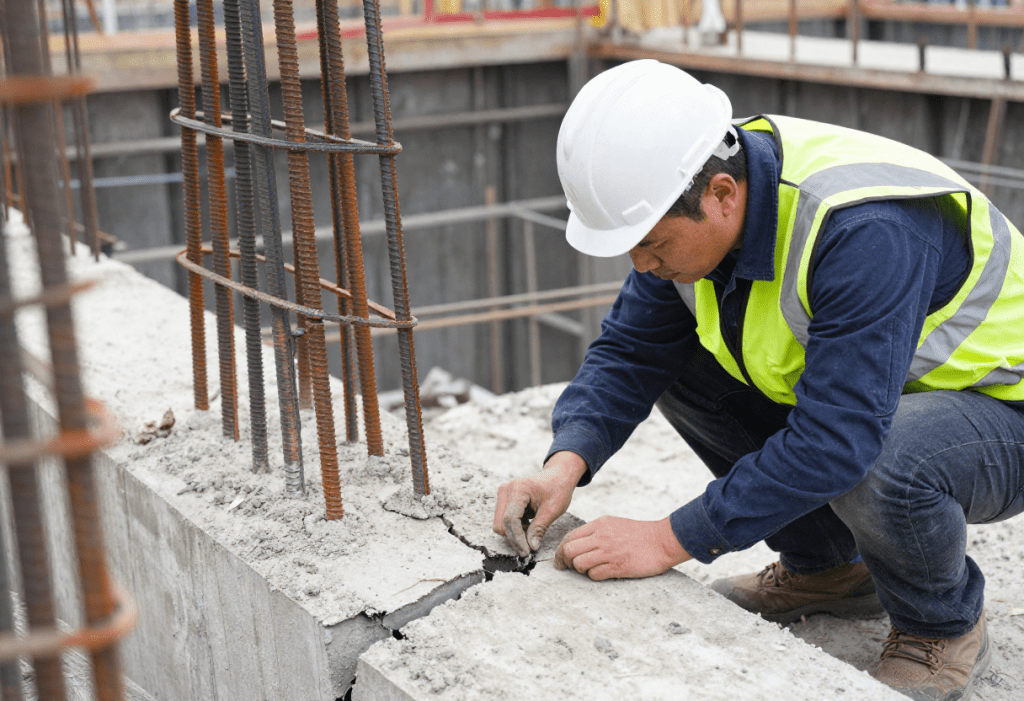
There’s never just one reason a foundation cracks. It is mostly a combination of natural settling, soil movement, weather changes, and time.
This is especially true for the Carolinas, where we deal with clay-heavy soil and big swings in moisture.
Now, the important thing that you should understand is this: Cracks are usually a symptom. They’re a sign that something moved, shrank, expanded, or shifted.
It doesn’t automatically mean danger, but it does mean something caused it.
Let’s look at some of the most common reasons for cracks in concrete foundation.
1. Concrete shrinkage
When concrete is first poured, it contains a surprising amount of water. That water is necessary to make it workable and strong.
But as the concrete cures and hardens, that moisture slowly evaporates. And this is when concrete shrinkage happens.
This shrinking process often creates small, thin cracks which:
- Usually appear within the first year
- Stay very narrow (often hairline)
- Don’t grow or spread over time
Think of it like drying mud in the sun, it naturally forms small surface cracks as it dries.
In fact, in most homes, concrete shrinkage cracks are cosmetic. They don’t affect the structure of your home and typically don’t require major repairs.
They’re simply part of how concrete behaves.
2. Soil movement under your foundation
Soil movement is one of the biggest causes of crack in concrete slab foundation in the Carolinas.
You see, a lot of our soil contains clay. And clay is very reactive to moisture.
So, when it rains, clay absorbs water and expands. And when it dries out during hot weather, it shrinks.
This constant cycle of swelling and shrinking puts pressure on your foundation.
Over time, this can:
- Push certain areas of the foundation upward
- Allow other areas to settle downward
- Create uneven support under the home
Now, when one part of your house moves differently than another, cracks do form. This uneven movement is often called differential settlement, but in simple terms, it just means the ground under your house isn’t moving evenly.
Thankfully, it is possible to stabilize a foundation on clay soil with proper moisture control and clay improvement.
3. Poor drainage and water pressure
If rainwater isn’t draining properly away from your house, it can soak into the soil next to the foundation.
And when that soil becomes saturated, it expands and pushes against the concrete walls.
This pressure is called hydrostatic pressure. Over time, this pressure can:
- Cause horizontal cracks in basement walls
- Create diagonal cracking
- Slowly push walls inward
- Weaken the overall structure
Poor grading, short downspouts, clogged drains, or heavy rainfall can all make this worse. In fact, many serious foundation problems actually start as drainage problems.
4. Temperature and moisture changes
Fresh foundation concrete might look solid and unmoving, but it actually expands and contracts with temperature and moisture changes.
This is especially true for the the Carolinas where we experience:
- Long, hot summers
- Cooler winter months
- Periods of heavy rain followed by dry spells
This constant back-and-forth creates slow, gradual movement in the concrete. Over the years, this repeated expansion and contraction leads to cracking, especially in exposed areas of the foundation.
5. Construction-related issues
Sometimes the cause of a crack in concrete foundation goes back to the day the foundation was built.
If the soil wasn’t properly prepared, or if the concrete wasn’t reinforced well, small weaknesses can develop. These issues might include:
- Not enough steel reinforcement
- Concrete that dried too quickly
- Uneven soil compaction before pouring
- Missing or poorly placed control joints
The tricky part is that construction-related cracks don’t always show up right away. A foundation might look perfectly fine for years before small stress points start to reveal themselves.
In short, here’s what causes cracks in concrete foundation:
| Cause | What Happens | Is It Serious? |
| Concrete Shrinkage | Concrete dries and shrinks after being poured | Usually harmless |
| Soil Movement | Clay soil expands when wet and shrinks when dry | Can become serious over time |
| Poor Drainage | Water builds up and pushes against foundation walls | Often serious if not fixed |
| Temperature Changes | Concrete expands and contracts with weather | Usually slow and minor |
| Construction Issues | Weak reinforcement or poor soil prep | Depends on severity |
Bonus: Here are the most common types of cracks in concrete foundation
| Crack Type | What It Looks Like | What It Usually Means | Level of Concern |
| Hairline Crack | Thin, straight line | Normal shrinkage | Low |
| Vertical Crack | Up-and-down crack | Minor settling | Low to Moderate |
| Diagonal Crack | Angled crack near corners | Uneven movement | Moderate |
| Stair-Step Crack | Step pattern in block walls | Soil pressure or movement | Moderate to High |
| Horizontal Crack | Side-to-side crack | Soil/water pressure pushing wall | High |
When is crack in concrete slab foundation a worry?

The crack itself usually isn’t the real problem. Foundation movement is the problem. And this goes for all types of home foundations.
You see, concrete can crack and still be perfectly stable. But when a crack signals that the foundation is shifting, settling, or getting pushed around, that’s when you need to pay attention.
So how do you know the difference?
Here are some signs that a crack in concrete foundation deserves a closer look.
1. The crack is getting wider
A crack that stays the same size year after year is usually not urgent.
But a crack that keeps opening up?
It tells you that the foundation is moving.
After all, concrete doesn’t stretch on its own. And if a crack is widening, something underneath or around the foundation is definitely shifting.
As a rule of thumb, if the crack grows wider than the thickness of a coin, and if you can see it changing over a few months, that’s worth inspecting.
Here’s an easy tip you can follow:
- Take a clear photo
- Measure the width
- Check it again in 60-90 days
If it’s larger, that’s a sign that the foundation movement hasn’t stopped.
2. The crack shows displacement
Displacement in a concrete foundation means the two sides of the crack are no longer lined up evenly.
Here, one side might be slightly higher, lower, or pushed inward compared to the other. And this difference in level tells you that the foundation isn’t just cracking, it’s shifting.
You might notice:
- A slight step when you run your hand across it
- One side sticking out further
- The wall no longer looking flat
When concrete moves out of plane like that, it often indicates structural movement rather than simple surface shrinkage. This is a strong warning sign that you shouldn’t ignore.
3. The crack is horizontal
Unlike vertical cracks, which are often related to normal settling, horizontal cracks usually form because pressure is pushing against the wall from the outside.
This pressure often comes from:
- Wet, heavy soil
- Poor drainage
- Water buildup around the foundation
You see, when soil presses hard enough, it can cause the wall to crack side-to-side, and sometimes even begin bowing inward.
So, if you see a horizontal crack in a basement or crawlspace wall, especially one that runs a long distance, it’s not something to ignore.
4. You also see signs inside your home
A single crack by itself might not be alarming. But when cracks show up along with changes inside your home, that combination can point to foundation movement.
This is likely a serious problem if you notice:
- Doors or windows suddenly sticking
- Floors that feel sloped or uneven
- Gaps forming around trim or ceilings
- Cracks in drywall that keep coming back
When these signs appear together, they often tell the same story: Something underneath the house is shifting.
5. The crack is near corners or load-bearing areas
Cracks in poured concrete foundation near the corners, large openings like garage doors, or along main support walls deserve more attention than small cracks in the middle of a wall.
Why?
That’s because corners and load-bearing walls carry more structural stress. And when cracks form in those high-stress zones, it can mean the foundation is struggling to distribute weight evenly.
This doesn’t mean every corner crack is a serious issue. But compared to a small, mid-wall surface crack, these areas are more critical to the home’s stability and they should be looked at more carefully.
In short, here are signs that a crack in concrete slab foundation is serious:
| Warning Sign | What It Means |
| Crack is getting wider | Foundation might still be moving |
| Crack shows displacement | Structure is shifting |
| Crack is horizontal | Wall might be under pressure |
| Doors/windows sticking | Foundation movement affecting structure |
| Sloping floors | Uneven settling |
| Wall bowing inward | Serious pressure problem |
| Crack near corners/support areas | Structural stress zone |
Don’t Let Site Conditions Delay Your Project
From geotechnical reports to environmental assessments, and more, our ACI-certified experts deliver the data and insights you need to stay on schedule.
Is repairing cracks in concrete foundation possible?

Yes, foundation cracks can absolutely be repaired.
But here’s the important part: The right repair depends on why the crack happened in the first place.
If it’s a small, non-structural crack caused by normal shrinkage, a simple crack injection can often seal it and prevent water from getting in. That’s a straightforward fix.
But if the crack formed because of soil movement, drainage problems, or pressure against the wall, sealing the surface alone won’t solve the real issue.
In these cases, the solution might involve improving drainage, adjusting grading around the home, reinforcing the wall, or even stabilizing the soil underneath.
Final words
Concrete foundations crack. That part is simply reality. After all, no home stays perfectly untouched by time, weather, and soil movement.
What isn’t normal is ongoing movement.
If a crack keeps widening, walls start shifting out of place, or pressure from soil and water is pushing against your foundation, that’s when it becomes something more than cosmetic.
The same goes for changes inside your home where sticking doors, uneven floors, or gaps around trim are signs your foundation might still be moving.
Got more questions or want to get concrete testing services?
You can get in touch with us!
At NewTech Engineering, we are seasoned concrete testing experts with over two decades of hands-on experience. All our engineers are ACI-certified and bring local Carolina-specific expertise.
FAQs about crack in concrete foundation
Are cracks in concrete foundation always a serious problem?
Not at all.
Most homes develop small foundation cracks over time, especially from normal concrete shrinkage and minor soil movement. These cracks usually stay thin and do not affect the strength of the house.
A crack becomes more concerning when it keeps getting wider, shows movement on one side, or appears along with other issues like sticking doors or sloping floors.
How can I tell if a crack in concrete slab foundation is getting worse?
The easiest way is to take a clear photo and measure the width of the crack. Check it again after a few weeks or months.
If the crack is wider than before, or if the edges no longer line up evenly, that is a sign of movement.
You should also pay attention to new indoor symptoms such as wall cracks, door gaps, or uneven floors, because these often appear when foundation movement continues.
Which type of crack in concrete foundation should worry me the most?
Horizontal cracks are usually the most serious type to watch for. They are often caused by soil and water pressure pushing against the foundation wall.
Stair-step cracks in block foundations and diagonal cracks near corners can also be a concern if they keep growing.
Small vertical or hairline cracks are usually less serious.
If you notice any wall bowing, inward movement, or widening cracks, it is a good idea to have a professional look at them.
Can cracks in concrete foundation cause water leaks inside the house?
Yes, they can.
Even small cracks can allow water to seep through when the soil around your foundation becomes very wet.
Over time, this can lead to damp walls, musty smells, and even mold problems.
Cracks combined with poor drainage make this more likely. That is why fixing water flow around your home, such as improving grading and extending downspouts, is just as important as sealing the crack itself.
Is fixing cracks in concrete foundation safe to do myself?
You can seal small, non-structural cracks to stop minor water leaks.
However, sealing alone does not fix the reason the crack formed. And if the soil is still moving or water pressure is still building up, new cracks can appear later.
So, before spending money on repairs, it is important to know whether the crack is only cosmetic or connected to foundation movement.
When should I call a professional to inspect a foundation crack?
You should call a professional if the crack is horizontal, keeps getting wider, shows visible movement, or is combined with other warning signs inside your home.
These include sloping floors, doors and windows sticking, or gaps around trim and ceilings.
If you feel unsure about what you are seeing, it is always better to get a proper inspection early.
Kerry Cooper is the founder of New Tech Engineering, He brings over 20 years of hands-on experience in geotechnical investigation, soil analysis, and foundation design across residential, commercial, and infrastructure projects. Kerry leads a team focused on delivering data-driven insights that help builders and developers make smarter, safer decisions from the ground up.