
What’s The Difference Between Phase 1 Vs Phase 2 Environmental Site Assessment?

By Kerry Cooper
Founder & Lead Geotechnical Engineer

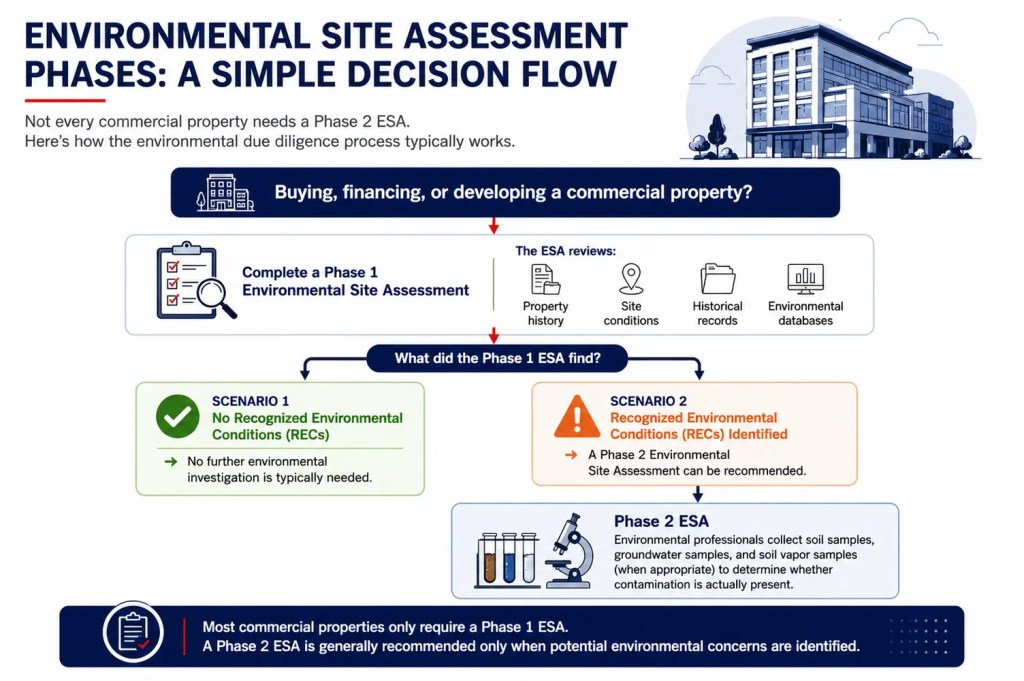
As I discussed in my previous blog, a phase 1 environmental site assessment is the first thing you’ll need before purchasing a property.
Now, you might also have come across the term phase 2 ESA. And if you’re like most property buyers, your first question will be: What’s the difference between phase 1 vs phase 2 environmental site assessment?
For starters, both phase 1 and 2 ESAs are part of the environmental due diligence process. They’re both used to assess environmental risks associated with a property, and both play an important role during a commercial real estate transaction.
But here’s the thing: A phase 1 ESA and a phase 2 ESA serve very different purposes.
A phase 1 environmental site assessment is designed to identify potential environmental concerns based on property history, records, and site observations.
A phase 2 environmental site assessment goes a step further. It involves actual environmental testing to determine whether contamination is present.
In this blog, I will explain it all. You’ll know:
- What a phase 1 environmental site assessment is
- What a phase 2 environmental site assessment is
- The biggest difference between phase 1 and phase 2 ESA
- What triggers a phase 2 ESA
- When you might need each assessment
So, let’s get into it.
Key takeaways
- A phase 1 ESA identifies potential environmental concerns based on research and site observations.
- A phase 2 ESA uses environmental testing to determine whether contamination is present.
- Most commercial real estate transactions begin with a phase 1 environmental site assessment.
- A phase 2 ESA is recommended only when environmental concerns are identified during a phase 1 ESA.
- Soil, groundwater, and vapor sampling are common components of a phase 2 environmental site assessment.
- Not every property requires a phase 2 ESA.
What is a phase 1 environmental site assessment?

A phase 1 environmental site assessment is the first step in the environmental due diligence process. Its purpose is to identify potential environmental concerns that could affect a property’s value, development plans, financing, or future ownership liability.
Think of it as a background check for a property. Here, environmental professionals investigate the property’s history and current conditions to determine whether there are signs of possible contamination.
The goal is simple: Identify whether past or present activities could have resulted in environmental issues.
For instance, environmental testing services look for evidence that a property might have been used for:
- Gas stations
- Auto repair facilities
- Manufacturing operations
- Dry cleaning businesses
- Chemical storage facilities
- Waste disposal activities
They also evaluate nearby properties because environmental contamination can sometimes migrate from neighboring sites.
To complete a phase 1 ESA, environmental consultants perform several tasks, including:
| Phase 1 ESA Step | What It Involves |
| Site Inspection | Visual inspection of the property to identify signs of environmental concerns, such as spills, stained soil, or storage tanks. |
| Historical Records Review | Review of past property uses through historical maps, aerial photos, ownership records, and previous reports. |
| Environmental Database Review | Search of local, state, and federal databases for nearby contamination, hazardous waste sites, or regulatory issues. |
| Interviews | Discussions with property owners, managers, occupants, or local officials to gather additional site history. |
| Written Phase 1 ESA Report | Summary of findings, identified environmental concerns, and recommendations for further action if needed. |
Now, one of the most important outcomes of a phase 1 ESA is determining whether any Recognized Environmental Conditions (RECs) exist.
Don’t let the term intimidate you.
A REC simply means there is evidence suggesting the presence or possible presence of contamination resulting from hazardous substances or petroleum products. And if a REC is identified, a phase 2 ESA can be recommended.
What is a phase 2 environmental site assessment?

A phase 2 environmental site assessment is a more detailed environmental investigation that involves actual testing and sampling.
Unlike a phase 1 ESA, which relies on research and observations, a phase 2 ESA collects physical evidence from the property. Here, the goal is to determine whether contamination is present and, if so, evaluate its extent.
To put it simply, a phase 2 ESA is designed to answer questions that a Phase 1 ESA cannot.
For instance, if a phase 1 ESA identifies a former gas station on the property, a phase 2 ESA can help determine whether petroleum contamination remains in soil or groundwater.
This is done through environmental sampling.
Depending on the property and the environmental concern being investigated, a phase 2 ESA can include:
- Soil sampling
- Groundwater sampling
- Soil vapor testing
- Indoor air sampling
- Laboratory analysis
Here, environmental professionals collect samples from specific locations and send them to certified laboratories for testing. The results then help determine whether contaminants are present and whether additional action is necessary.
Phase 1 vs phase 2 environmental site assessment: What’s the difference?
Now that we’ve covered what each assessment does, let’s answer the question you’re most curious about: What is the difference between phase 1 vs phase 2 environmental assessment?
The the biggest difference is this:
- A Phase 1 ESA identifies potential environmental concerns.
- A Phase 2 ESA investigates those concerns through environmental testing.
A phase 1 environmental assessment is considered a non-intrusive investigation. Environmental professionals review records, inspect the property, and evaluate its history, but they do not collect samples or perform laboratory testing. This is also why the overall phase 1 ESA cost is lower than phase 2.
A Phase 2 environmental assessment, on the other hand, is an intrusive investigation. It involves collecting soil, groundwater, vapor, or other environmental samples to determine whether contamination is actually present.
Here’s a side-by-side comparison of phase 1 vs phase 2 environmental site assessment:
| Category | Phase 1 ESA | Phase 2 ESA |
| Purpose | Identify potential environmental concerns | Confirm whether contamination exists |
| Testing Required | No | Yes |
| Soil Sampling | No | Yes, when needed |
| Groundwater Sampling | No | Yes, when needed |
| Site Inspection | Yes | Often included |
| Historical Research | Yes | Might be reviewed |
| Laboratory Analysis | No | Yes |
| Typical Trigger | Property transaction or financing | Environmental concerns identified during Phase 1 |
| Goal | Assess environmental risk | Determine presence and extent of contamination |
In short, both phase 1 and phase 2 environmental assessment services work together. Phase 1 ESA identifies potential problems while phase 2 ESA helps determine whether those problems are real.
What triggers a phase 2 environmental site assessment?
One of the biggest misconceptions about phase 1 vs phase 2 environmental site assessment is that every phase 1 ESA automatically leads to a phase 2 ESA.
That’s not true.
In fact, most phase 1 environmental site assessments are completed without recommending any additional investigation.
A phase 2 ESA is only recommended when the Phase 1 assessment identifies environmental concerns that require further evaluation.
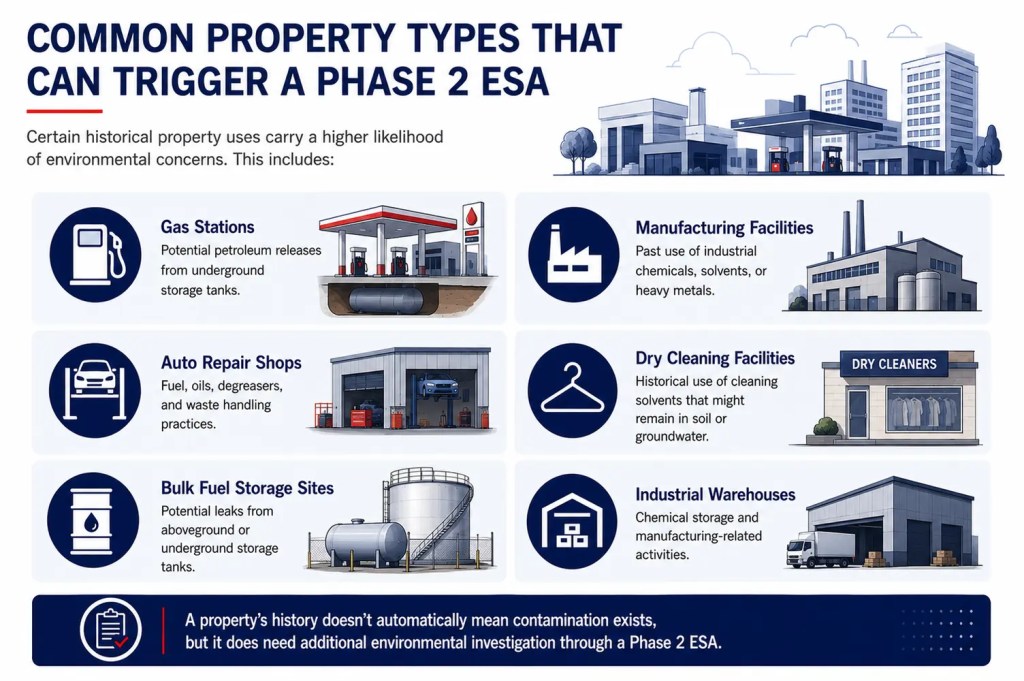
Here are some of the most common examples:
1. Former gas stations
Gas stations are one of the most common reasons a phase 2 ESA is recommended.
You see, even if fuel pumps and tanks were removed years ago, petroleum releases might still have occurred.
So, if historical research shows the property once operated as a gas station, environmental professionals recommend soil or groundwater testing to assess potential impacts.
2. Underground storage tanks
Underground storage tanks, also called USTs, can present environmental risks if leaks have occurred.
Even if tanks are no longer in service, they can raise concerns during a phase 1 ESA. So if evidence of current or former USTs is found, a phase 2 investigation is recommended to determine whether contamination exists.
3. Manufacturing operations
Properties with a history of manufacturing often receive additional scrutiny. That’s because manufacturing facilities might have used:
- Solvents
- Petroleum products
- Industrial chemicals
- Heavy metals
A phase 2 ESA helps determine whether these materials affected soil, groundwater, or other environmental media.
4. Dry cleaning facilities
Dry cleaning operations have historically used chemicals that can persist in the environment for many years.
And even if the business closed decades ago, contamination might still remain. For this reason, former dry cleaning sites require additional phase 2 ESA.
5. Evidence of spills or improper chemical handling
Sometimes environmental concerns are identified during the site inspection itself. For instance, the environmental professional might observe:
- Stained soil
- Damaged chemical storage areas
- Evidence of leaks
- Improper waste handling practices
These conditions do raise questions that a phase 1 ESA alone cannot answer, thus necessitating a phase 2 assessment.
6. Nearby environmental concerns
Not all environmental risks originate on the property being evaluated.
In some cases, contamination from nearby properties can migrate through soil or groundwater and affect neighboring sites.
So, if regulatory databases identify nearby contamination sources, additional testing can be recommended.
Does every phase 1 ESA lead to a phase 2 ESA?
The short answer is no.
People assume that once a phase 1 environmental site assessment is completed, a phase 2 ESA automatically follows.
But that’s rarely the case.
In fact, most commercial properties never require a phase 2 environmental site assessment. That’s because the majority of phase 1 ESAs do not identify significant environmental concerns.
So, if the assessment finds no evidence of Recognized Environmental Conditions (RECs), the environmental consultant will conclude that no further investigation is necessary. Here, the environmental due diligence process will end with the phase 1 ESA.
A phase 2 environmental site assessment is only recommended when there is enough evidence to justify additional investigation.
For instance, let’s say historical records show that the property once operated as a gas station, but there’s no information about whether underground storage tanks were properly removed. In this case, the consultant might recommend limited soil sampling and laboratory soil testing to better understand the situation.
On the other hand, if the property has a long history of low-risk uses, such as office space, there’s no reason to proceed with a phase 2 ESA.
Simply put, the decision is based on the findings of the phase 1 assessment, not on a predetermined process.
When do you need a phase 1 vs phase 2 environmental site assessment?
Now that you understand the difference between phase 1 and phase 2 ESA, you might be wondering when each one is actually needed.
The answer depends on the property and the transaction.
Let’s look at the most common situations.
Here’s when you Need A Phase 1 ESA:
A phase 1 environmental site assessment is typically the starting point for environmental due diligence. It is commonly recommended when you’re:
- Purchasing commercial real estate
- Applying for commercial financing
- Developing a property
- Refinancing certain commercial properties
- Buying industrial or higher-risk properties
- Wanting to better understand a property’s environmental history
Many lenders across North and South Carolina require a phase 1 ESA before approving financing because it helps them evaluate environmental risks that could affect the property’s value.
For buyers, a phase 1 ESA provides valuable information before closing and can help prevent costly surprises later.
Here’s when you Need A Phase 2 ESA:
A phase 2 environmental site assessment is generally only performed after a phase 1 ESA identifies environmental concerns that require additional investigation. Some common reasons include:
- A Recognized Environmental Condition (REC) was identified.
- The property has a history of industrial or commercial activities associated with hazardous materials.
- There is evidence of a past spill or release.
- Underground storage tanks are present or were previously located on the property.
- A lender, buyer, or regulatory agency requests additional environmental information.
Now, it’s important you know that a phase 2 ESA is not designed to replace a phase 1 ESA. Instead, it builds on the findings of the phase 1 assessment by collecting environmental samples and providing more definitive answers.
In other words, these assessments aren’t competing services. They work together to help buyers, lenders, developers, and property owners better understand environmental risk before making important financial decisions.
Conclusion
When comparing phase 1 vs phase 2 environmental site assessment, the biggest difference comes down to one thing:
- Phase 1 ESA identifies potential environmental concerns.
- Phase 2 ESA determines whether those concerns are actually causing contamination through environmental testing.
Commercial real estate transactions begin with a phase 1 ESA because it provides the information buyers and lenders need to evaluate environmental risk. And in many cases, that’s all that’s required.
However, if the phase 1 assessment identifies potential environmental concerns, a phase 2 ESA is recommended to gather additional information before moving forward.
Got more questions or need a phase 1 or 2 environmental site assessment in North and South Carolina?
You can get in touch with us!
At NewTech Engineering, our team provides thorough phase 1 and phase 2 environmental site assessments for commercial real estate transactions, developers, lenders, and property owners throughout the Carolinas.
Whether you need environmental due diligence for a property purchase or additional investigation following a phase 1 ESA, we’ll provide clear, reliable information to help you move forward with confidence.
FAQs about phase 1 vs phase 2 environmental site assessment
What is the difference between a phase 1 and phase 2 environmental site assessment?
A phase 1 environmental site assessment identifies potential environmental concerns by reviewing property records, historical information, regulatory databases, and current site conditions.
A phase 2 environmental site assessment goes a step further by collecting soil, groundwater, vapor, or other environmental samples to determine whether contamination is present.
What is a phase 2 ESA?
A phase 2 ESA is an environmental investigation that involves field sampling and laboratory testing to evaluate whether contamination exists on a property.
It is typically recommended when a Phase 1 ESA identifies potential environmental concerns that require further investigation.
Does every phase 1 ESA require a phase 2 ESA?
No.
Most phase 1 environmental site assessments do not lead to a phase 2 ESA.
Additional investigation is usually recommended only if the phase 1 assessment identifies Recognized Environmental Conditions or other environmental concerns.
Does a phase 1 ESA include soil testing?
No.
A standard phase 1 ESA does not include soil, groundwater, or vapor testing.
If environmental testing is needed, it is typically performed as part of a phase 2 environmental site assessment.
Which assessment is required by lenders?
In many commercial real estate transactions, lenders require a phase 1 environmental site assessment as part of the financing process.
A phase 2 ESA is generally requested only if the phase 1 assessment identifies environmental concerns that could affect the property’s value or increase lending risk.
How long do phase 1 and phase 2 ESAs take?
A phase 1 ESA is often completed within two to four weeks, depending on the property’s size, complexity, and the availability of historical records.
A phase 2 ESA timeline varies because it involves fieldwork, laboratory testing, and analysis. The overall schedule depends on the scope of the investigation and the types of samples being collected.
Is a phase 2 ESA more expensive than a phase 1 ESA?
Yes.
A phase 2 environmental site assessment typically costs more because it involves drilling, sampling, laboratory analysis, specialized equipment, and additional fieldwork.
However, it provides valuable information that can help buyers and lenders make informed decisions when potential environmental concerns are identified.
Kerry Cooper is the founder of New Tech Engineering, He brings over 20 years of hands-on experience in geotechnical investigation, soil analysis, and foundation design across residential, commercial, and infrastructure projects. Kerry leads a team focused on delivering data-driven insights that help builders and developers make smarter, safer decisions from the ground up.